How to document a travel request workflow
By Phil KlingUpdated June 2026How we research this
To document a travel request workflow, record the real process from request to booked trip, then generate a step-by-step SOP and a process map from it. Travel requests stall on policy checks and approval routing that employees cannot see, so they guess and get returned. Ledgerium records the real request and approval in the browser, captures the policy checks and routing, and generates the SOP, the process map, and a report that shows where requests wait and where they get sent back.
Key takeaways
- Travel requests stall on policy checks and approval routing that employees cannot see, so they guess and get returned.
- Most travel delay is the wait for approval before booking, where prices change while a request sits.
- A travel policy buried in a document nobody opens leads employees to submit requests that miss limits and resubmit as fares climb.
- Ledgerium measures time to approval and return rate and flags requests stalled beyond the target approval time.
Who uses this workflow
Employees requesting travel, managers and finance approvers, and the operations lead who owns the travel policy. Finance reviews it when testing travel spend controls.
Systems involved: Travel or expense system, Email and calendar, Booking or agency portal.
The old way
The travel policy lives in a document nobody opens and the approval routing is unclear. Employees submit requests that miss policy limits, get returned, and resubmit while fares climb.
With Ledgerium
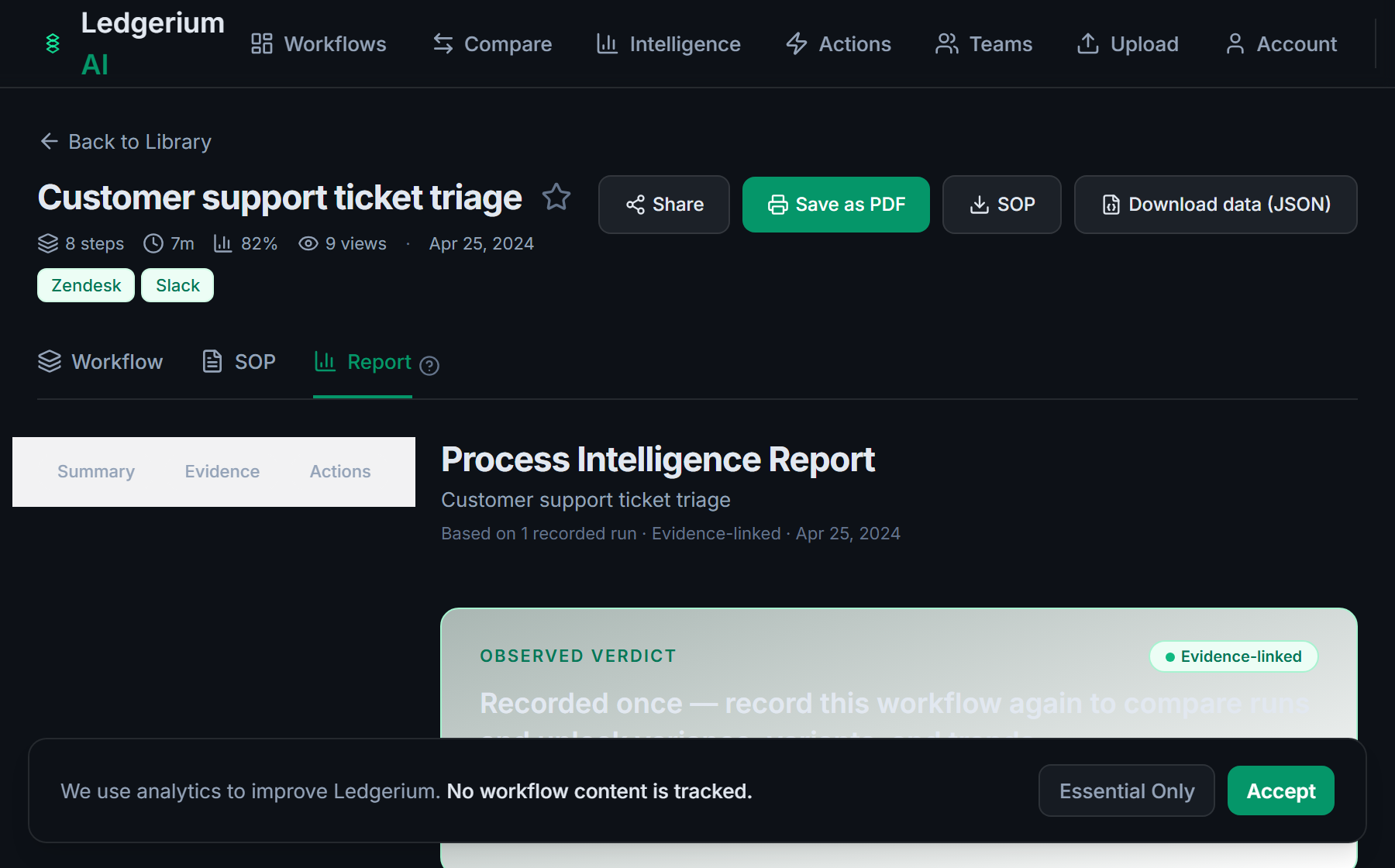
Record one real travel request and approval. Ledgerium captures the policy checks and routing and generates the SOP, the process map, and a report that highlights where requests wait and why they get returned.
Sample workflow steps
- 1
Submit the request
The employee enters the trip with dates, destination, purpose, and estimated cost.
- 2
Check against policy
Verify the request against travel policy limits and any pre-trip approval rules.
- 3
Route for approval
Send to the right approver based on cost, destination, or trip type.
- 4
Approve or return
The approver confirms the trip or returns it for changes.
- 5
Book the trip
Book flights, lodging, and ground travel against the approved request.
What Ledgerium generates from this
Metrics Ledgerium can reveal
- Time to approval: Submission to approval, split into policy check and approval wait.
- Return rate: Share of requests returned for changes before approval.
- Pre-booking wait: How long an approved request waits before the trip is booked.
Common mistakes
- Leaving the policy limits undocumented, so employees submit requests that get returned
- Documenting the request but skipping the approval routing rules
- Not capturing how long requests wait before approval while prices change
AI and automation opportunities
- Pre-check the request against policy limits before it routes for approval
- Suggest the correct approver from cost and destination rules
- Detect requests stalled beyond target approval time and escalate them
How Ledgerium captures this
Ledgerium captures a travel request workflow by recording the real path from request through the policy check and approval routing to a booked trip, so the report shows how long a request waits between submission and approval while fares move.
1. Install the extension
Add the Ledgerium recorder to Chrome. No screenshots and no keystrokes are ever captured.
2. Record the real workflow
Perform the process once. Ledgerium captures the structured steps, timing, and system context.
3. Get the output
Receive an SOP, a process map, and a workflow intelligence report generated from the real work.
Worth knowing
Bookings completed by a travel agent over phone or email are not captured. Ledgerium records the browser-based request, approval, and self-service booking steps; offline booking needs a note.
Frequently asked questions
- Typically: submit the request, check it against policy, route for approval, approve or return it, then book the trip. The policy limits and approval routing are the parts employees most often cannot see.
- Record one real request and approval, then generate the SOP and process map from it. This captures the policy checks and routing that the written policy usually leaves vague.
- Usually because a policy limit was missed or the trip needed pre-approval that the employee did not know about. Recording a real request makes the actual rules visible and reduces rework.
- Yes. A single recording captures the browser-based steps across the travel system, email, and the booking portal, so the SOP and process map show the real approval and booking path.
- Common candidates are pre-checking requests against policy, suggesting the right approver, and escalating stalled requests. Ledgerium scores these from the recorded process.
Not ready to sign up? Try the live demo — no login required.
Capture this workflow once
Record the real process and turn it into an SOP, a process map, and an AI opportunity report, generated from how the work actually happens.
Free plan includes 5 documented workflows per month. No screenshots ever captured.
Or Install the extension first.