How to document a vendor setup workflow
By Phil KlingUpdated June 2026How we research this
To document a vendor setup workflow, record the real process of adding a new vendor from request to active master record, then generate a step-by-step SOP and a process map from it. Vendor setup carries control risk, the tax and banking checks decide whether payments are safe, yet those checks are rarely written down clearly. Ledgerium records the real setup in the browser, captures the validation and approval routing, and generates the SOP, the process map, and a report that shows where requests wait and where they get returned.
Key takeaways
- Vendor setup carries control risk because the tax and banking checks decide whether payments are safe.
- The control points in vendor setup are the tax and banking validations, and that is where requests get returned.
- Validation rules living in tribal knowledge mean each clerk validates differently and some checks get skipped under pressure.
- Ledgerium measures return rate and validation completeness and flags duplicate vendor records before a new one is created.
Who uses this workflow
Procurement requesters, vendor master data and accounts payable staff, and the finance approver who owns the control. Auditors review it when testing payment and supplier controls.
Systems involved: ERP or accounting system, Vendor or supplier portal, Tax or banking validation tools, Email.
The old way
The setup steps and the validation rules live in tribal knowledge, so each clerk validates a little differently. Some checks get skipped under time pressure, which is exactly how bad banking details slip into the master record.
With Ledgerium
Record one real vendor setup. Ledgerium captures the request, the tax and banking validation, the approval routing, and activation, and generates the SOP, the process map, and a report that highlights where requests get returned.
Sample workflow steps
- 1
Receive the vendor request
A requester submits the new vendor with category, contact, and supporting documents.
- 2
Enter vendor master data
Create the vendor record with name, address, terms, and payment details.
- 3
Validate tax and banking
Verify the tax registration and banking details against required evidence.
- 4
Route for approval
Send to the finance approver based on category and spend thresholds.
- 5
Activate the vendor
Approve and activate the vendor so it is available for purchase orders and payment.
What Ledgerium generates from this
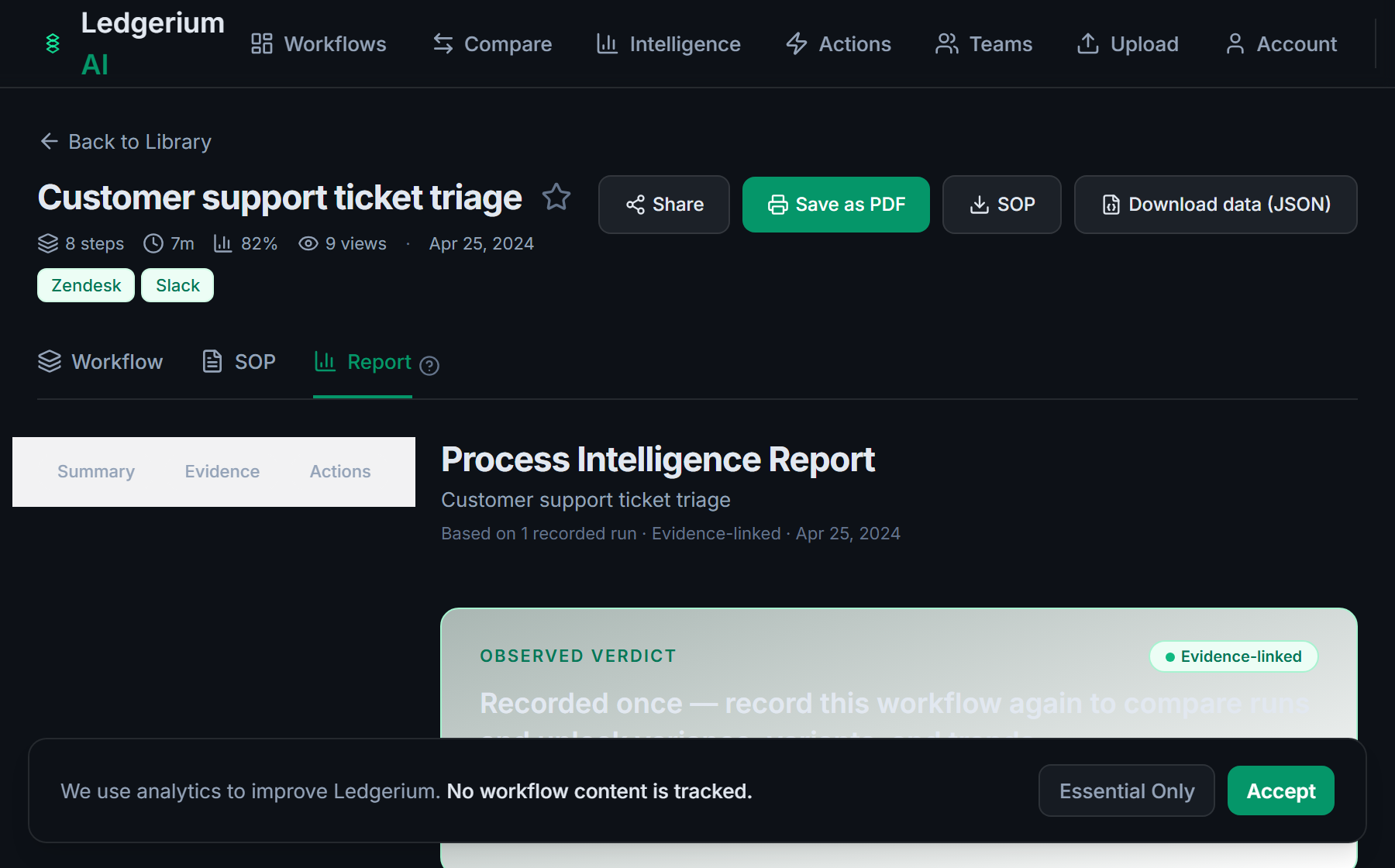
Metrics Ledgerium can reveal
- Time to activate: Request received to active vendor, split into work and wait time.
- Return rate: Share of vendor setups returned for correction before approval.
- Validation completeness: Share of activated vendors with all required checks recorded.
Common mistakes
- Leaving the tax and banking validation rules undocumented, so checks vary by clerk
- Documenting the request but skipping the approval routing and activation steps
- Not capturing how often setups get returned and at which validation
AI and automation opportunities
- Pre-check tax and banking details against required evidence before approval
- Auto-flag duplicate vendor records before a new one is created
- Detect setups stalled beyond target validation time and escalate them
How Ledgerium captures this
Ledgerium captures a vendor setup workflow by recording the real path from request through tax and banking validation and approval routing to an active master record, so the report shows how often setups bounce back at banking validation.
1. Install the extension
Add the Ledgerium recorder to Chrome. No screenshots and no keystrokes are ever captured.
2. Record the real workflow
Perform the process once. Ledgerium captures the structured steps, timing, and system context.
3. Get the output
Receive an SOP, a process map, and a workflow intelligence report generated from the real work.
Worth knowing
Validations confirmed by phone with a bank or tax authority outside the browser are not captured. Ledgerium records the browser-based setup steps; offline confirmations need a note.
Frequently asked questions
- Typically: receive the vendor request, enter the master data, validate tax and banking, route for approval, then activate the vendor. The tax and banking validations are the control steps most guides leave vague.
- Record one real setup from request to activation, then generate the SOP and process map from it. This captures the validation rules and the approval routing that tribal knowledge usually hides.
- Most often at tax or banking validation, where evidence is missing or details do not match. Capturing each validation step shows how often setups bounce back and at which check.
- Yes. A single recording captures the steps across each browser-based system in the setup, the accounting system, the vendor portal, and validation tools, in one pass.
- Common candidates are pre-checking tax and banking details, flagging duplicate vendors, and escalating stalled setups. Ledgerium scores these from the recorded process.
Not ready to sign up? Try the live demo — no login required.
Capture this workflow once
Record the real process and turn it into an SOP, a process map, and an AI opportunity report, generated from how the work actually happens.
Free plan includes 5 documented workflows per month. No screenshots ever captured.
Or Install the extension first.